Robin Mitchell Fellowship 2018, Carlyn Davie
As my ST4 year draws to a close, I am fortunate enough to be spending the last few weeks of it in Baltimore thanks to Medic One and The Robin Mitchell Fellowship. I was awarded the fellowship back in February and I have been hotly anticipating the opportunity to have time to develop myself, learn something new and ultimately share my experiences with my colleagues.
The aim of my trip was to get exposure to and learn about a peer-led resilience programme (RISE) that is offered to hospital staff experiencing stressful events at Johns Hopkins, experience another health care system with observation in the Emergency Department at Johns Hopkins Hospital and to attend the summer institute course on Human Factors and Patient Safety at the Bloomberg School of Public Health of The Johns Hopkins University.
My experience to date in the field of human factors is mostly through simulation training, where there has been an emphasis on situational awareness, team dynamics, effective leadership and communication. As a department we also discuss cases at our monthly M&M meetings and when looking at why things have gone wrong or our performance has been suboptimal we often reference Reason’s Swiss cheese model of accident causation. Throughout my training so far there is also frequent reference to high-performing industries such as aviation, their approach to safety and how healthcare can learn from such industries. I was interested to learn more about human factors and the concept of human factors engineering, changing the system and the processes to “designs out” errors. The science of human factors accepts that healthcare professionals, like all humans, make errors. Human factors experts focus on designing systems that make it “easy to do things right and hard to do things wrong.”
During my first week in Baltimore I attended the human factors in patient safety course. The course was predominantly delivered by Dr Ayse Gurses and Dr Mike Rosen. Dr Gurses is the Director of the Armstrong Institute Centre for Health Care Human Factors. She is a human factors engineer with expertise in patient safety, healthcare technology design and usability evaluation. Her areas of interest include transitions of care/handovers and working conditions for nursing staff. Dr Rosen is a human factors psychologist with special interest in the areas of teamwork and patient safety as well as simulation-based training, performance measurement and quality and safety improvement.
Lectures included an overview of human factors engineering (HFE), physical ergonomics, cognitive ergonomics, teamwork in patient safety, macro-ergonomics, introduction to HFE methods, retrospective and prospective risk assessment methods and an overview of organisational theory. I am by no means now an expert in the field of human factors but I have definitely learnt some essential concepts, methods and tools which can be applied to patient safety interventions and quality improvement efforts.
I am sure we can all agree that working in an emergency department can at time be stressful, busy, emotionally charged and requires us to move from one case to the next often without thought or hesitation. There is also a well- recognised issue with recruitment and retention of all staff in the specialty of emergency medicine. Our department attracts some of the most compassionate, hard- working and kind staff you will find anywhere in the hospital and I was interested to find out what steps other organisations take to support their staff and encourage resiliency. In addition, how do they support them when they feel overwhelmed, things have not gone well or there has been an adverse event.
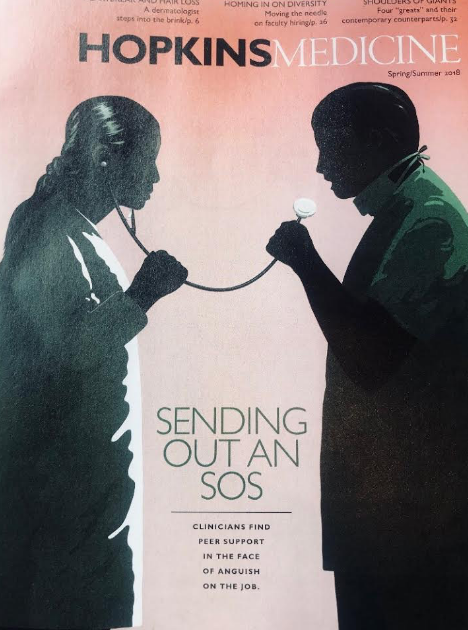
I spent time at The Johns Hopkins Hospital learning about RISE (Resilience in Stressful Events). This is a peer-led support programme that is offered to all staff throughout the hospital. I have been intrigued and interested to find out why this was implemented, how it works, what the culture of their organisation is like and has it worked.
The literature states that organisations often fail to recognise the impact of adverse events on healthcare providers who can suffer emotional distress after the same incidents that harm patients. The concept of the healthcare worker as a “second victim” and the hospital often as a “third victim” is frequently mentioned. Those who become a “second victim” can experience a wide range of adverse effects including sleep disturbance, anxiety and even depression. This in turn leads to healthcare workers who are distressed and at risk of making further mistakes. There may be an increased rate of sick leave and subsequent turnover of staff which can be costly to an organisation.
The Johns Hopkins Hospital is only one of a few hospitals in the United States to adopt a peer-led support programme. It was implemented initially on the paediatric ward in 2011 when several second victims were identified after a tragic and highly publicised death of child on the ward as a result of an adverse event. The programme was subsequently rolled out hospital wide in 2012. There are currently 35 trained peer providers who take it in turn to be “on-call” for the week.
The mission of RISE is “to provide timely support to employees who encounter stressful patient-related events - defined as including adverse events, medical errors, deaths, unexpected outcomes, non-accidental trauma, and difficult or violent interactions. Support is offered 24 hours per day and seven days per week in a peer-to-peer or group format depending on the request. The support is provided by peers: colleagues who work in the hospital environment and who have been trained to provide appropriate support.” It is confidential and completely separate from any investigation into how an adverse event occurred.
The programme is led by Professor Albert Wu. He is a Professor of Health Policy and Management and Medicine at Johns Hopkins. He leads the Armstrong Institute centre for measures of quality of care and patient safety and is a leading expert on disclosure and the psychological impact of medical errors on both patients and caregivers.
I have spent time with several members of the RISE team, allowing me an opportunity to pick their brains and find out firsthand what it is like being a RISE provider. They were also able to give me some insight into the culture of their organisation and how it has changed over the years. I spent time with Matt Norvell the paediatric hospital chaplain, his main role is to provide emotional support to patients and families so it seemed a great fit that he was involved in RISE. I met up with Cheryl Connors who is a paediatric nurse and patient safety specialist with the Armstrong Institute for Patient Safety and Quality. Cheryl co-led the development of the RISE programme. Lastly, I met Laurie Rome a paediatric oncology nurse. I attended a monthly event that she facilitates held on the paediatric oncology ward called “Processing and Resilience Sessions.” This event was open to all staff on the ward. The goals of the session were to promote resilience, help with processing distressing events, learning strategies to manage stress, a forum to support each other and share stories and allow staff to get to know each other off the “shop floor.”
Everyone I have spoken to is incredibly positive about RISE and its importance, not just those directly involved in the programme. Everyone is aware of the programme and support its existence. They report a big drive throughout the hospital to improve staff resilience and note that in a very competitive and academic institution there has been a definite culture change and that people are more open and supportive. The programme has been fully supported and embraced by senior clinicians and hospital management. I have loved the opportunity to learn about a novel programme of peer support and I am interested to explore some specific aspects of this going forward and hope that we could take even some baby steps towards improving how we look after and support our own staff. I appreciate we may not experience adverse events every day but we do experience suffering and some traumatic situations on a daily basis and this in addition to the pressures of the environment we find ourselves working in means we are more susceptible to feeling stressed and are subsequently at risk of burnout.