
Robin Mitchell Fellowship 2024, Jocelyne Velupillai
I had the privilege of being awarded the RM fellowship in 2023 to visit the Gold Coast Simulation Service, which sits within Gold Coast University Hospital (GCUH) in Gold Coast, Australia.
Why Gold Coast Simulation Service ?
Having had a keen interest in simulation for a while, I wanted to visit the GCUH sim service because they stand out as international leaders in the world of sim.
In particular, it is a centre of expertise in using simulation as a tool to directly improve patient care, rather than indirectly through staff education, demonstrating that investment in sim offers value for money. Their focus on using simulation as a tool to improve patient care led them to develop the concept of “translational sim” which refers to the use of sim specifically for the purpose of testing systems and processes.
What makes GCUH even more unique is that simulation is fully embedded into the everyday running of the hospital. It is not treated as an occasional teaching exercise dependent on enthusiastic staff working around clinical shifts - it sits in a unit of its own, separate to all department, and functions almost like a consulting service. Different departments can approach them with a problem, and if simulation lends itself well to solving the problem, the sim team and clinical team work together to co-design projects.
The simulation service, developed over several years by Professor Victoria Brazil, offered a model I had not seen elsewhere, and one I felt we could learn from. The opportunity to learn directly from internationally recognised educators such as Professor Brazil and Dr Eve Purdy was also a strong motivator!
My time in Gold Coast
The Gold Coast team were incredibly welcoming. I was welcomed with an amazing lunch (fresh from the fish market) and taken straight to a surf competition in the Gold Coast sun - what an arrival! The following day I began my attachment.
During my 4 weeks in the GCUH simulation service, I got to take part in several different workstreams:
1) I attended the faculty development programme run at the start of each year, a series of half day workshops open to all disciplines of clinical staff;
2) I observed and participate in weekly simulation taking part on ICU, medical wards and ED;
3) I participated in two translational simulation projects;
4) I was a clinical observer in the ED to gain insight into how this approach makes a difference to teams and systems in the GCUH and Robina Hospital emergency departments.
What did I learn ?
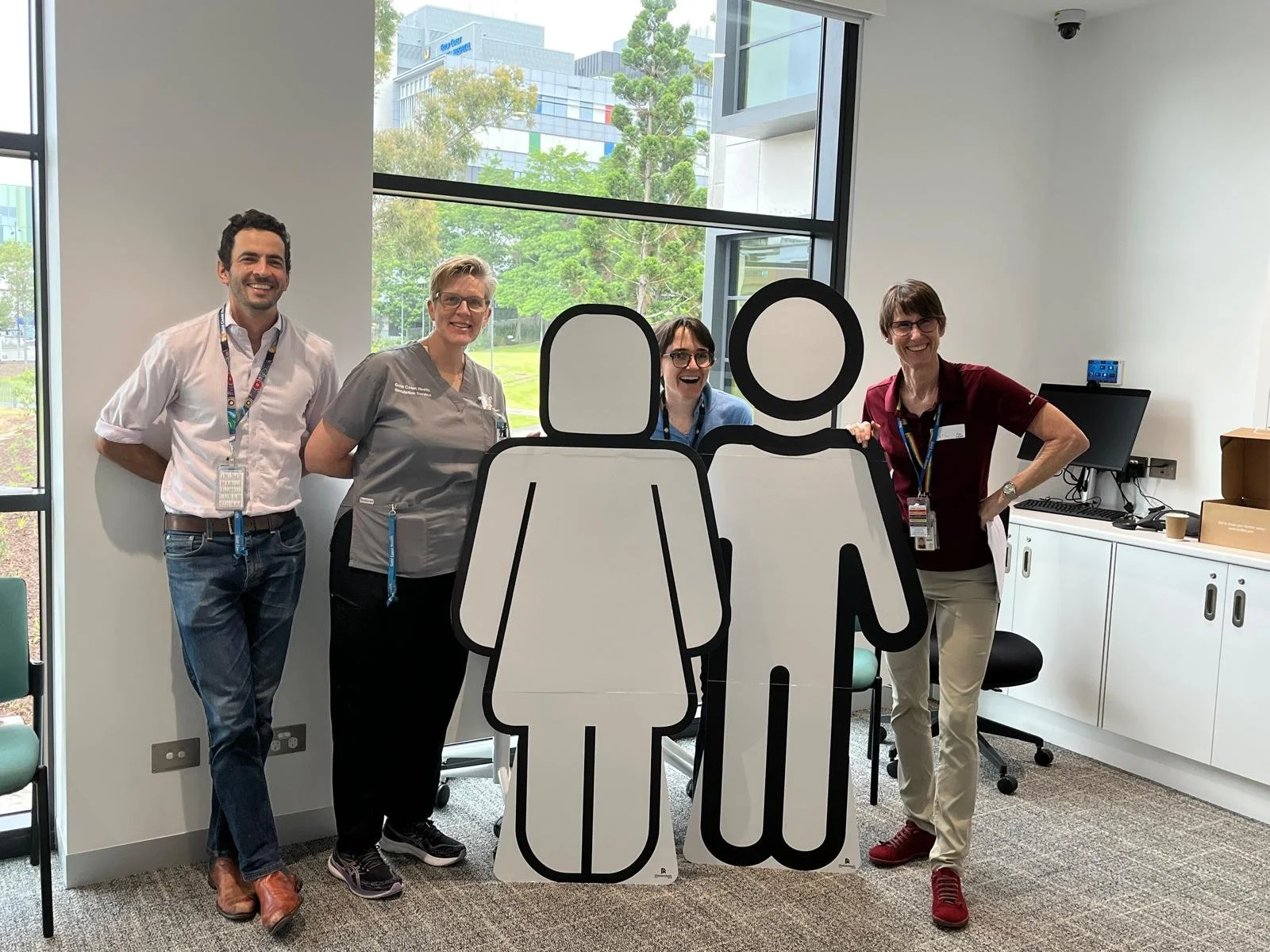
The faculty program allowed me to develop skills as an educator. My main take home message from attending the faculty development program was about matching the modality of simulation to your learning outcomes. I learnt that if you want to explore how teams work together, you might not need a high tech mannikin but instead could use flat paper cut outs of patients and equipment!VEMS, or visually enhanced mental simulation, is a simulation modality that is frequently used at GCUH. It’s a modality in which laminated paper is used as the simulator to encourage think-aloud techniques of learning. It’s very portable and low cost but does require an experienced facilitator to run smoothly.
I also learned a lot about psychological safety. Psychological safety in a team is when the team members feel able to speak out and ask questions without fear of judgement or reprisal – an important pre-requisite to create a supportive learning atmosphere. We can promote psychological safety by building a sense of familiarity within teams and having clear expectations. In GCUH, this means they tell participants what’s in the sim before they do it! I was amazed to see how well this worked and allowed more reluctant participants to fully engage. Over the course of my time in GCUH I realized that a lot of the skills required to be a good facilitator overlap with skills I can use to help ED teams perform better clinically.
Taking part in simulation for education across several units also allowed me to see how interprofessional simulation (rather than “uniprofessional” sim) is their expected baseline. “Uni-professional” simulation projects are very rarely undertaken at GCUH in order to prioritise training in real clinical teams.
I had the opportunity to take part in 2 translational sim projects where simulation was used to test the safety of a new clinical space. It was inspiring to see the logistics, healthcare and operational teams come together to find issues in the new clinical space by testing them with simulated emergencies.
What was very special about the GCUH sim service is how they use simulation as an opportunity to shape their workplace culture. Dr Eve Purdy explains that sim is where we tell stories about our work. This is both an opportunity and a risk: the GCUH simulation team uses this opportunity to send positive messages. For instance, they ensure the whole team is invited to take part in translational sim projects, including portering and security teams. This allows them to recognize the invaluable contributions of each member of a team to their clinical environment and help flatten hierarchical differences between disciplines and grades.
They also think about the longevity of their simulation service. The simulation service team was made up exclusively of staff with a nursing background, which is quite different from my experience in the UK. This helps balance some of the hierarchy but also means that the service is run by permanent staff, who are more likely to enact change, be better embedded in teams and systems, and therefore contribute to the sustainability of the sim service.
The Gold Coast team could not have been more welcoming. Outside of work, I was taken on hikes in the Hinterland to see waterfalls, beach days and visits to the Gold Coast animal sanctuary (where you can watch their operating rooms through glass as they happen live - really cool!)
What I learnt in GCUH is that simulation is not so much about what your resources are, but what your mindset is:
Carefully matching your chosen simulation modality with your objectives can allow you to be judicious about your resources. Embedding simulation into everyday activities of the hospital creates a culture of learning and safety, which strengthens both teams and systems.
Learning about psychological safety and other concepts has benefited me as an educator, but also as a clinician.
If you want to read more from some of the concepts I mention here, these are my top 5 papers and 1 podcast episode:
VEMS
Brazil V, Speirs C, Scott C, Schweitzer J, & Purdy E. (2025). Recommendations for the design and delivery of Visually Enhanced Mental Simulation: insights from participants and facilitators. Journal of Healthcare Simulation from 10.54531/NDXV6633. https://www.johs.org.uk/article/doi/10.54531/NDXV6633
Psychological safety
Rudolph JW, Raemer DB, Simon R. Establishing a safe container for learning in simulation: the role of the presimulation briefing. Simul Healthc. 2014 Dec;9(6):339-49. doi: 10.1097/SIH.0000000000000047. PMID: 25188485. https://pubmed.ncbi.nlm.nih.gov/25188485/
Purdy E, Borchert L, El-Bitar A, Isaacson W, Bills L, Brazil V. Taking simulation out of its "safe container"-exploring the bidirectional impacts of psychological safety and simulation in an emergency department. Adv Simul (Lond). 2022 Feb 5;7(1):5. doi: 10.1186/s41077-022-00201-8. PMID: 35123580; PMCID: PMC8818167. https://pubmed.ncbi.nlm.nih.gov/35123580/
Translational simulation
Brazil V, Reedy G. Translational simulation revisited: an evolving conceptual model for the contribution of simulation to healthcare quality and safety. Adv Simul 9, 16 (2024). https://doi.org/10.1186/s41077-024-00291-6.
Sim and culture
Brazil, V., Purdy, E., Alexander, C. et al. Improving the relational aspects of trauma care through translational simulation. Adv Simul 4, 10 (2019). https://doi.org/10.1186/s41077-019-0100-2
One podcast episode ( I would recommend all simulcast episodes ! )78 - Advances in Simulation: Transmitting Culture Through Simulation - Simulcast